Consultancy
Consultancy
With a background in Environmental Science and Waste and Resource Management, we have developed ETD Consultancy Limited to provide a range of services and resources for domestic properties, for home owners and landlords, throughout central Scotland.
Energy Performance Certificate
An EPC provides an energy efficiency rating in relation to your property’s running costs. In order to produce a legally valid EPC, an accredited Domestic Energy Advisor (DEA) will need to collect the following information for your property:
- Property Type (e.g. flat, house)
- Property age
- Number of floors and dimensions (to produce a floor plan)
- Glazing type and amount of glazing present
- Build type (e.g. brick, stone, timber frame)
- Insulation present at roof, walls and floors
- Heating system/s and fuel type/s
- New technologies (e.g. solar panels, heat pumps)
An EPC is required when your property is marketed for sale or rent. In these cases it is advised that you book an EPC as soon as possible as not having a valid EPC can slow down the sale of a property and you cannot legally advertise your property for rent until you obtain one. Some grants and loans for energy saving initiatives may also require an EPC.
Please note: If you intend to sell or rent your property and already have a valid EPC, it may still be worth considering renewing it if you have had any work completed that may contribute to greater energy efficiency. This may include new double glazing or heating system or the installation of new technologies e.g. solar panels, heat pumps, wind turbine etc.
An EPC is valid for 10 years or until a newer EPC is lodged for the same property regardless of how many times the property is sold or rented during that time.
The easiest way to check if your property has a valid EPC is to visit www.scottishepcregister.org.uk.
Please note: this is the official and only register for Scotland and it is a free service. There are web sites that request a fee to provide you with a link to your EPC or a copy of your EPC but we feel this is unnecessary as it is quick, easy and free for you to access via the link provided above.
The EPC can be viewed by entering the report reference number (RRN) on the document (this is a 20 digit number which is on the top right hand corner of the EPC), the RRN is five groups of four digits separated by dashes, e.g. 1111-2222-3333-4444-5555. This is helpful if you have a paper copy of your EPC but would like an electronic copy.
If you do not have this reference number, you can enter your postcode. The search facility will only allow you to view the current valid document for a building.
Please note: not all EPCs are available on the register as central lodgement was phased in.
EPC data available is as follows:
- All buildings which were newly constructed, with a building warrant application made after 9 January 2013
- Dwellings sold or rented to a new tenant after 1 December 2008; and
- Non-domestic buildings sold, rented to a new tenant and public buildings from January 2013.
The cost of an EPC can vary depending on several factors including: the size of your property, and travel costs. It can also cost more if you use a price comparison site. These sites will search for DEAs in your area but can be more costly than contacting DEAs directly as they may add administration charges.
The table below provides a breakdown of the cost.
Cost | Explanation |
Assessment Submission Fee | Accrediting schemes charge for each assessment submitted and include the cost of using software, quality assurance and Professional Indemnity (PI) and Public Liability (PL) insurance. |
Central Registration Fee | EPCs are required to be submitted to the Central Register held by the Scottish Government. The statutory fee is set by the Scottish Government on an annual basis. |
Site Visit | Site visits take approximately 1 hour (longer if a Legionella Risk Assessment is also undertaken). |
Administration | Includes the input and upload of data, calculations and photographic evidence, the production of a floor plan and lodgement onto central register. |
We charge a set fee of £39.99 for an average sized property (typically 1-5 bedrooms, 2-3 reception rooms)*.
*A surcharge may be required for larger properties as they will take longer to assess. Please contact us to discuss and we can confirm the fee before booking.
Exterior or property: Take photographs and site notes for property exterior to evidence property, roof and glazing types.
All rooms: Take photographs and site notes for light fittings, radiators, room dimensions and feature e.g. open fires.
Bathrooms/shower rooms : Take photographs and site notes for bathroom fittings and light fittings.
Lofts: Take photographs and measurements of insulation type, depth and location and evidence of build type and party wall type.
Gas and electricity meters: Take photographs and note types of meters present.
To ensure we gather all the correct information as quickly as possible it is handy to be prepared beforehand.
Access: Please make sure we have access to all external elevations of your property, all rooms, the loft space, gas and electric meters, boiler and hot water tank.
Paperwork: This is really important if you have had wall/floor or roof insulation as the DEA can only record what they can see during inspection or what can be proved with certificate of completion and invoices etc. It is also useful to have any documentation or manuals for boilers and new technologies e.g. heat pumps or solar panels. The more accurate the information the more accurate the Energy Performance Certificate will be.
Safeguarding: Please ensure that any pets or children are supervised at all times. DEAs will need to enter every room so please remove and store safely anything you do not wish to be in sight including personal and valuable items.
Increasing your energy performance: Something as simple as changing to energy efficient light bulbs can increase your energy performance rating.
Please see our handy EPC Preparation Guide for more details.
Please feel free to contact us for a chat as we’re happy to provide more information and talk you through the process.
Joanne Dunn
07725479371
Legionella Risk Assessment
Legionnaires’ disease is a potentially fatal form of pneumonia, which can affect anybody. It is caused by the inhalation of small droplets of water from contaminated sources containing legionella bacteria.
A LRA is an assessment that should detail:
- management responsibilities, including the name of the competent person and a description of the system
- competence and training of key personnel
- any identified potential risk sources
- any means of preventing risk or controls in place to control risks
- monitoring, inspection and maintenance procedures
- records of the monitoring results and inspection and checks carried out
- arrangements to review the risk assessment regularly, particularly when there is reason to suspect it is no longer valid
If it is concluded that there is no reasonable foreseeable risk or the risks are low and are being properly managed to comply with the law, the assessment is complete. There may be no need to take any further action at this stage, but any existing controls must be maintained and the assessment reviews regularly in case anything changes in the system.
A LRA is required when your property is marketed for rent. It is advised that you book an LRA as soon as possible as you cannot legally advertise your property for rent until you obtain one.
The Health and Safety Executive (HSE) states that landlords have a legal duty to assess and control the risk associated with legionella bacteria in order to ensure the safety of their tenants.
A Legionella Risk Assessor will have the required competence to undertake a full legionella risk assessment, and can also provide an output report to demonstrate compliance with the relevant Codes of Practice.
You should review your legionella risk assessment at least every two years as a minimum.
You can use search engines to find a LRA in your area but please ensure they have a valid qualification and accreditation. LRAs should also have a Disclosure Scotland and Professional Indemnity (PI) and Public Liability (PL) insurance.
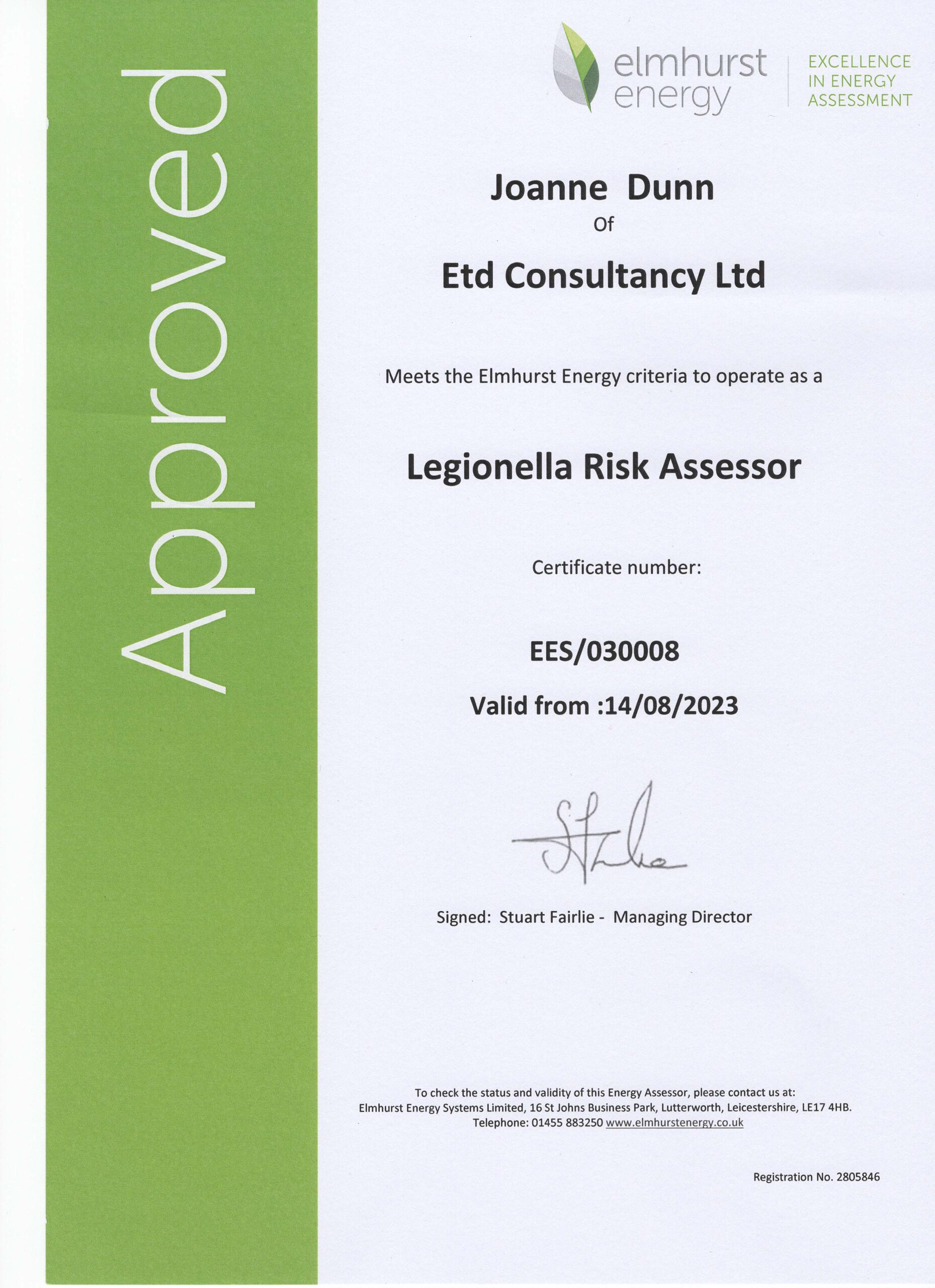
Please see documentation below for our LRA:
The cost of an LRA can vary depending on several factors including: the size of your property, and travel costs. It can also cost more if you use a price comparison site. These sites will search for LRAs in your area but can be more costly than contacting LRAs directly as they may add administration charges.
The table below provides a breakdown of the cost.
Cost | Explanation |
Assessment Submission Fee | Accrediting schemes charge for each assessment submitted and include the cost of using software, quality assurance and Professional Indemnity (PI) and Public Liability (PL) insurance. |
Site Visit | Site visits take approximately 30 mins (longer if an Energy performance Certificate is also required). |
Administration | Includes the input and upload of data and photographic evidence. |
We charge a set fee of £39.99 for an average sized property (typically 1-5 bedrooms, 2-3 reception rooms)*.
*A surcharge may be required for larger properties as they will take longer to assess. Please contact us to discuss and we can confirm the fee before booking.
The LRA will take temperature readings, site notes and photographs to record and risk assess the following:
- Property details
- Details of water system/s
- Water temperature at outlets
- Cold water storage
- Hot water storage
- Little used/unused outlets
- Shower heads, taps and other spray outlets
- Blind ends in pipework
- Spa pools, hot tubs, whirlpool baths
- Unoccupied properties
- Tenants
A schematic drawing of the water system and an assessment summary are also generated.
To ensure we gather all the correct information as quickly as possible it is handy to be prepared beforehand.
Access: Please make sure we have access to all external elevations of your property, all rooms, the loft space, boiler and hot water tank.
Paperwork: Where possible, provide details of any previous risk assessments, written control scheme and its implementation and results of any inspection, tests or checks carried out and the dates. Please note: while landlords don’t necessarily need to create a written report, keeping a formal record of all risk assessments and steps taken to control the risks is advised in case you are asked to produce such records.
Safeguarding: Please ensure that any pets or children are supervised at all times. LRSs will need to enter most rooms so please remove and store safely anything you do not wish to be in sight including personal and valuable items.
Please feel free to contact us for a chat as we’re happy to provide more information and talk you through the process.
Get in Touch
Accreditations